Glamping site finance
Funding for glamping sites of pods, domes, safari tents and cabins, sized on build cost, end value and the trading income each pitch genuinely earns.
Funding glamping sites
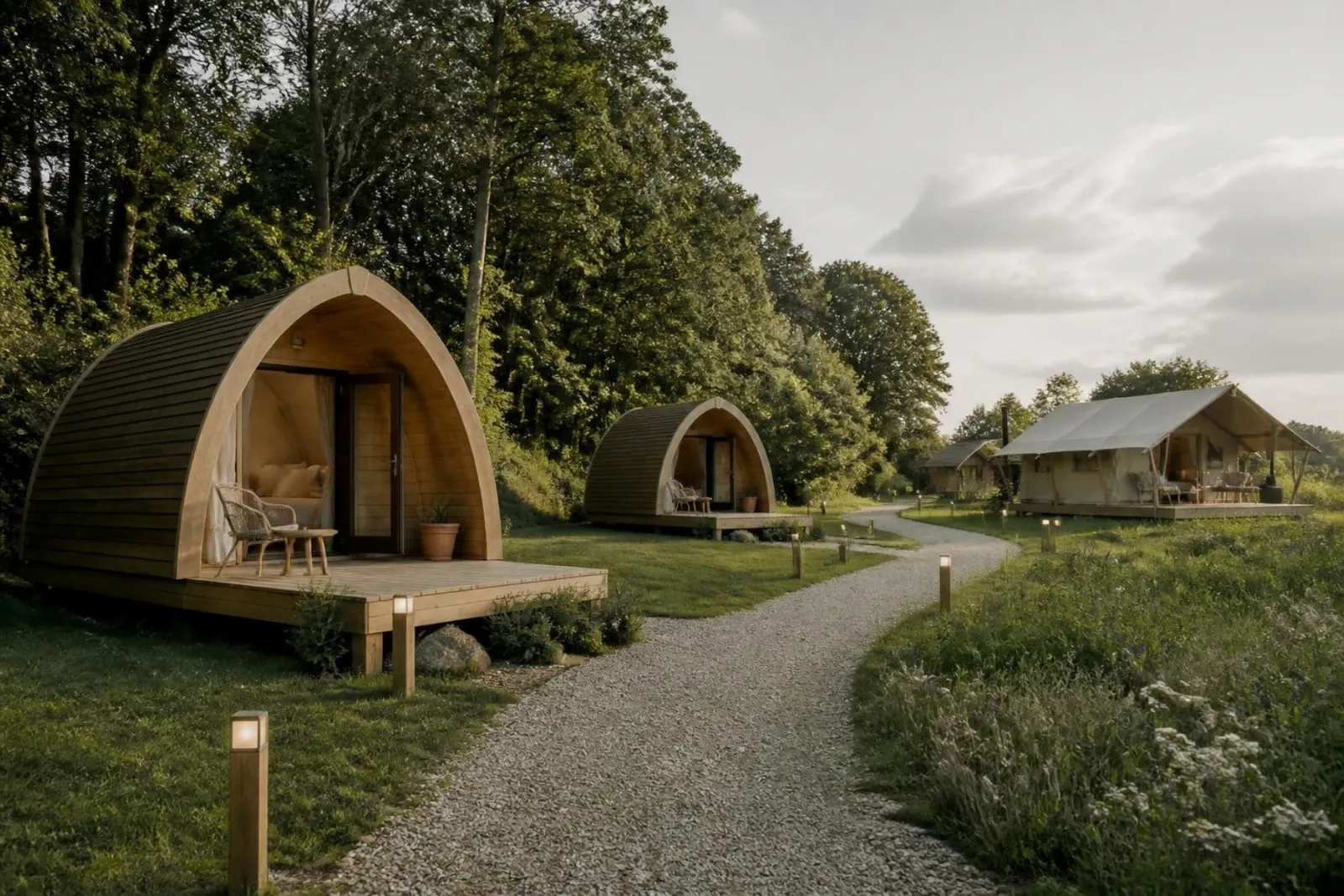
A glamping site is a holiday park built around high-specification camping units rather than static caravans: insulated pods, geodesic domes, safari tents, timber cabins, treehouses and shepherd's huts, each let nightly or by the short break to guests who want the outdoors with comfort. The capital cost per unit is far lower than a lodge or a static, yet a well-located unit can earn a strong nightly rate through the season, which produces high revenue per pitch on modest investment. Many glamping sites begin as farm diversification, adding income to land that already exists, and the segment has grown quickly across the UK as guests seek distinctive short breaks close to home.
That economics shapes the finance. Planning consent and a site licence sit at the centre of every case, because a glamping operation needs the right permissions for the units, the access and the facilities before it can trade. Lenders fund these sites against build cost and projected end value where works are involved, and against trading income once the site is established, underwriting the business rather than a residential valuation. Infrastructure is lighter than a static park, but seasonality bites harder, so the income case has to be honest about the shoulder months. We arrange this finance as an arranger and introducer, not a lender, and we do not give financial, legal or tax advice.
What we fund
- New glamping sites of pods, domes, safari tents and cabins
- Farm diversification adding glamping income to existing land
- Expansion of an established site with additional pitches and units
- Glamping let nightly and by the short break through the main season
- Sites funded against build cost and projected trading end value
Indicative terms
- Typical lot size (indicative)£150k to £3m and above
- Commercial LTV (indicative)Up to ~50 to 65% of value
- Development funding (indicative)Up to ~60 to 70% of cost
- Term rates (indicative)From around 7% (indicative)
Indicative only. Terms vary by lender, asset and borrower and are not an offer of finance.
How is a glamping site financed?
We arrange finance against the cost of building the site and the trading income it will earn, not a residential loan to value. For a new or expanding site, development and expansion funding advances against build cost, indicatively up to 60 to 70 percent, covering groundworks, services, units and facilities, with the lender testing the planning consent, the site licence and the projected income before drawing. Once the site trades, the debt moves onto a term facility sized on the business, indicatively up to 50 to 65 percent of value at rates from around 7 percent, with cover tested against a sensible occupancy across high and low season rather than a peak figure. Because glamping is trading-led, the underwriting follows the revenue per pitch and the operator's plan, not a bricks-and-mortar number. We arrange and introduce throughout; we are not a lender, and we do not give tax advice. Figures are indicative and not an offer of finance.
Which lenders fund glamping sites?
Glamping sites are funded by commercial and leisure lenders rather than residential or buy-to-let lenders, because a glamping park is a trading business secured on the land it operates from. The lender field is more specialist than for a conventional commercial property, since a credit team has to be comfortable with units that are not permanent buildings, with seasonal income and with a relatively young, fast-growing segment. The questions are consistent: is the planning consent in place for the units and the use, is there a valid site licence, what occupancy and nightly rate is realistic for this location across the season, and what experience does the operator bring to running it. Lenders weigh the diversification story where the site sits alongside a farm or an existing business, and they look at access, services and the depth of visitor demand nearby. Matching the site to a lender that genuinely understands glamping economics is most of the work, and it is exactly what we do.
Why do investors and lenders back glamping sites?
Glamping pairs low capital cost per unit with strong revenue per pitch, which is why the segment has grown so quickly and why lenders will back a credible site. A well-located pod or dome can earn a premium nightly rate through the main season on a fraction of the investment a lodge demands, and the model adds income to land that often already exists. UK glamping is a fast-growing segment, with the market forecast to see strong double-digit growth (Polaris Market Research, indicative). For the operator that supports several routes forward: refinance onto a term facility once a trading record is built, expand the site with further units against the proven income, or sell an established operation to a buyer who prices the earnings. The land underneath provides a floor, and the planning consent and licence carry real value. Lenders back the site where the income case is honest and the operator is capable, which is the case we build.
Finance that suits this asset class
- Glamping & lodge development financeFunds groundworks, services, units and facilities for a new or expanding glamping site against build cost and projected end value.
- Park development & expansion financeSuits a larger glamping scheme or a site adding many pitches alongside other park infrastructure.
- Leisure & trading-business park mortgagesProvides the term facility a glamping site moves onto once it trades, sized on the income the pitches earn.
Useful calculators
Related guides
Fund a glamping sites deal
A view on fundability within one working day.
What is a glamping site as a finance asset?
A glamping site is a holiday park whose accommodation is high-specification camping rather than static caravans or lodges: pods, geodesic domes, safari tents, cabins, treehouses and shepherd's huts, let nightly or by the short break. For finance purposes the defining features are a low capital cost per unit, a high potential revenue per pitch, and a trading character that depends on active letting and management through the season. That places a glamping site firmly in the commercial and leisure category, funded as a trading business rather than valued as residential property.
The distinction matters because it sets the whole lending conversation. A static park carries permanent infrastructure and a large capital base; a glamping site carries lighter infrastructure and a younger income record, but it can produce a strong return on modest cost. Lenders therefore size the debt on the projected and actual trading income, on the strength of the planning consent and site licence, and on the operator's plan, rather than on a property valuation alone. We arrange finance across the spectrum, from a first farm-diversification site to an established multi-unit operation, sizing the debt on what the pitches genuinely earn.
Why do planning and the site licence sit at the centre?
Glamping looks informal, but it is governed like any other holiday accommodation. A site needs planning consent for the units and the use, and a site licence from the local authority that sets the terms on which it can operate, including pitch numbers, layout, services and seasonal restrictions. Lenders read both documents closely, because they define what the site is allowed to do and therefore what income it can lawfully earn. A site operating ahead of its consents, or relying on permitted development that has run out, is a risk a lender will price or decline.
The licence term and the planning conditions also shape the structure of the loan. A site licensed only for part of the year carries a shorter trading window than one with year-round consent, and the income projection has to reflect that honestly. We help borrowers present the planning and licence position clearly, with the trading income mapped to what the consents actually allow, because a lender that can see the permissions are sound and the income lawful is a lender that can fund with confidence. We arrange and introduce; we do not give planning or legal advice.
How do lenders underwrite glamping trading income?
Glamping is underwritten on trading income, not on a residential rate. The lender starts from a realistic projection: the nightly rate each unit commands, the occupancy achievable across high, shoulder and low season, and the costs of running and marketing the site. Where the site already trades, booking history and accounts carry the case; where it is new, a credible projection set against comparable sites and genuine local demand stands in. The lender then tests that the income covers debt service with headroom through the quieter months, because a glamping site earns hard in summer and far less in winter.
Revenue per pitch is the figure that distinguishes glamping. A small number of well-run units in a strong location can produce income out of proportion to their capital cost, and lenders that understand the segment will recognise that rather than penalising the modest valuation. We present the income the way a leisure credit team expects to read it, conservative on occupancy and honest on seasonality, because an income case that survives scrutiny is the one that funds. Figures used in any projection are indicative and not an offer of finance.
Why is glamping a strong farm diversification?
Glamping has become one of the most common ways for a farm to diversify, because it turns under-used land into an income stream without the capital demand of permanent buildings. A field with a view, an access track and a connection to services can carry pods, domes or safari tents that earn through the season, and the farming business gains a second leg that is far less exposed to commodity prices and subsidy change. For many landowners that is the difference between a holding that runs at the margin and one that generates real surplus.
From a lending point of view, a diversification site sits within an existing business with land, accounts and management already in place, which can strengthen the case where the figures stack up. Lenders will still want the planning consent and site licence in order, the income projection grounded in real demand, and a clear plan for running the accommodation, since farming and hospitality are different disciplines. We arrange finance that works alongside the farm's existing borrowing and structure, presenting the diversification as the credible income it is, and we make no comment on the tax treatment, which is for the borrower's accountant.
What does seasonality mean for a glamping loan?
Seasonality is the central risk in glamping finance. The units are lighter and less weatherproof than a lodge, demand concentrates in the warmer months and over school holidays, and many sites are licensed for a defined season rather than the full year. That produces income that arrives in a burst and thins to little in winter, which a lender has to fund around rather than ignore. An income case built on peak-season figures alone will not survive underwriting, and it should not.
The way to fund well through seasonality is to be honest about it. We present occupancy and rate across the full season, show the costs that continue when the units are empty, and demonstrate that the operator can carry the quiet months, whether from reserves, from other income or from a facility structured with that pattern in mind. Some sites extend the season with insulated units, hot tubs and winter packaging, which strengthens the case; others accept a shorter window and size the debt accordingly. Lenders back a glamping site where the seasonality is faced squarely, and that honest presentation is exactly what we provide.
Worked example: a six-unit glamping site on a working farm
A farming family plans a glamping site of six insulated pods on a field with established access and a view, expecting to let through a main season from spring to autumn with some winter trade. Planning consent is granted, a site licence is in place, and the projected income is built on a conservative occupancy across high and shoulder season. The total build cost for groundworks, services, pods and a small facilities block is around £420,000.
We arrange development and expansion finance advancing indicatively 65 percent of cost, around £273,000, drawn in stages against the works, with the family funding the balance from the farm. Once the site trades through its first season and the income is evidenced, the debt moves onto a term leisure facility sized on the business, indicatively up to 55 to 60 percent of the site's trading value, at a rate reflecting the segment and the security. The farm's existing land and accounts support the case.
This is illustrative only, not an offer of finance, and the figures are indicative and depend on the lender, the site and the trading evidence at the time.
Illustrative worked example only. Figures vary by lender, asset and borrower and are not an offer of finance.
Frequently asked questions
Can I get finance for a glamping site that has not started trading yet?
Yes. A new glamping site is funded on development and expansion finance against build cost and projected end value rather than on a trading history it does not yet have. The lender will want planning consent and a site licence in place or clearly achievable, a credible income projection set against comparable sites and genuine local demand, and a clear plan for running and marketing the accommodation. Funds are drawn in stages against the works, and once the site trades through a season the debt typically moves onto a term leisure facility sized on the actual income. We arrange both stages and present the case the way a leisure lender expects to read it. We are an arranger, not a lender.
How much can I borrow against a glamping site?
Glamping is funded as a trading business, so the leverage reflects income and cost rather than a residential loan to value. As an indication, development and expansion finance advances up to around 60 to 70 percent of build cost, and a term facility on an established site advances up to around 50 to 65 percent of trading value, with rates from around 7 percent. The actual figure depends on the planning and licence position, the strength and seasonality of the income, the operator's experience and the lender. These figures are indicative and not an offer of finance. We size the debt to what the site genuinely earns and match it to a lender active in the segment.
Do lenders treat glamping pods as permanent buildings?
Usually not, and that is part of why glamping needs specialist lending. Pods, domes, safari tents and many cabins are not permanent buildings, so a lender securing against the site is lending against the land, the planning consent, the site licence and the trading business rather than against bricks and mortar. That narrows the lender field to commercial and leisure credit teams comfortable with the model. It also means the income case carries more weight, since the value sits in the operation more than in the structures. We match glamping sites to lenders that understand this and present the security and the income accordingly. We do not give legal or valuation advice.
Is glamping income reliable enough to support a loan?
It can be, provided the case is presented honestly. Glamping income is seasonal, concentrated in the warmer months and over holidays, and a projection built on peak figures alone will not survive underwriting. A strong case shows occupancy and nightly rate across high, shoulder and low season, the costs that continue when units are empty, and evidence that the operator can carry the quiet months. Where the site already trades, booking history and accounts make the point directly. Lenders back glamping where the income is realistic and the seasonality is faced squarely. We build that case and match it to a lender that prices the segment fairly. Figures used are indicative and not an offer of finance.
Funding a glamping sites asset?
Tell us about the deal and we will come back with a view on fundability and likely terms.